Enforcing Fairness via Constraint Injection with FaUCI
2nd Aequitas Workshop on Fairness and Bias in AI at ECAI 2024
🎤 Matteo Magnini, Giovanni Ciatto, Roberta Calegari, Andrea Omicini

Context
What do we mean by fairness?
Fairness has different meanings to us depending on our personal background.



For people with predominantly scientific studies, fairness is something that should be objectively measurable. This is usually translated into the fulfillment of one or multiple fairness metrics.
Context
Enforcing Fairness in ML models
Pre-processing
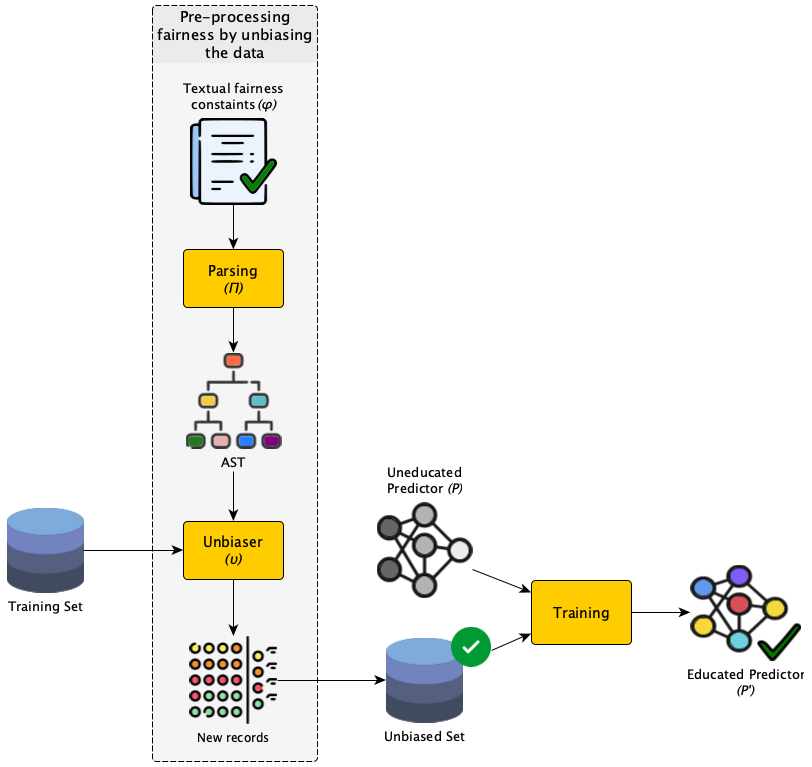
Methods that operate at dataset level to remove biases for sensitive groups.
In-processing
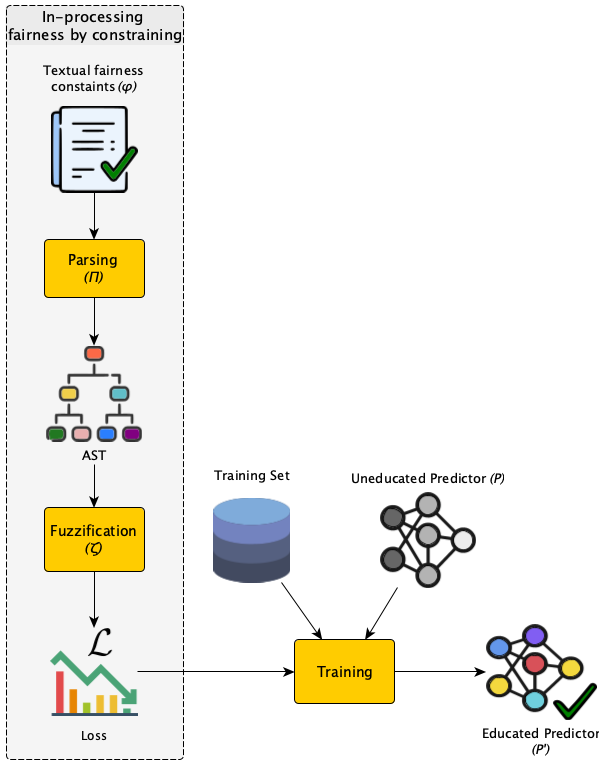
The training of the model takes into account the fairness constraints.
Post-processing
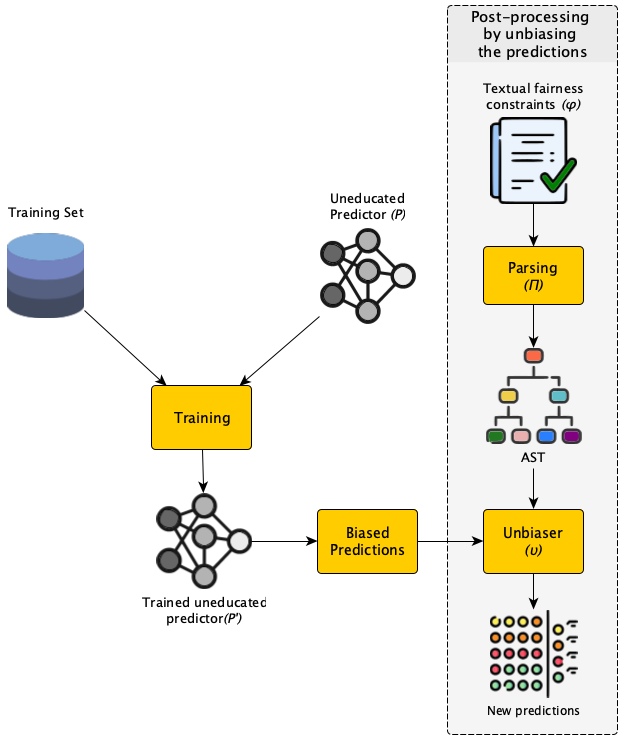
The model is treated as a black-box and only the predictions are adjusted to ensure fairness.
Context
The in-processing techniques
Penalty function
A function, usually derived from a fairness metric, is chosen to measure a violation of fairness/bias. This function takes into account the input data and the model’s predictions.
Function computation
Because fairness metrics require statistical distributions to be computed, these distributions are estimated on a subset (batch) of the data. The actual computation of the fairness metric is therefore done during the loss computation.
Training
The loss function is a combination of the model’s loss (e.g., binary cross entropy) and the fairness penalty. it is common to use a hyperparameter to balance the two terms.
Open challenges
Types of protected attributes
Binary

It is the simplest case, where the protected attribute can take only two values. There are only two groups to be considered, the classic example is the gender.
Categorical

The protected attribute can take more than two values. Here things start to get tricky, as we might consider all the groups for fairness. Examples are ethnicity, education, and occupation.
Continuous

The protected attribute is a continuous variable. This is the most complex case, as we need to estimate probability densities to compute fairness metrics. An example is the income.
Open challenges
Fairness metrics
Group vs. Individual fairness
Group fairness is about treating groups equally, while individual fairness is about treating similar individuals equally.
Individual fairness metrics are more computationally expensive and because of that less common in practice.
However, also group fairness metrics can be computationally expensive. For this reason, we decided to focus on group fairness metrics.
- Demographic/statistical parity how much model’s predictions are independent of the protected attribute. $$DP_{h, A}(X) = \sum_{a \in A} \left|\left| E[h(X) \mid A{=}a] - E[h(X)] \right|\right|$$
- Disparate impact how much the model disproportionately affects a group. $$DI_{h, A}(X) = \min\left(\frac{E[h(X) \mid A{=}1]}{E[h(X) \mid A{=}0]},\frac{E[h(X) \mid A{=}0]}{E[h(X) \mid A{=}1]}\right)$$
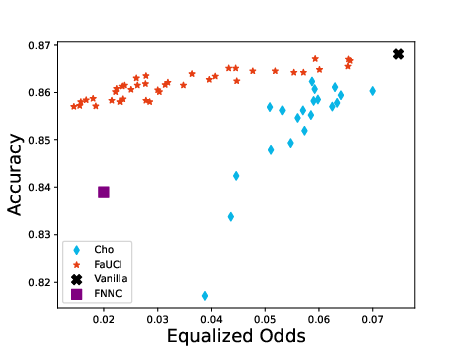
- Equalized odds how much the model equally predicts a given output for all the groups. $$EO_{h, A}(X) = \sum_{(a, y)}^{A \times Y} eo_{h, A}(X, a, y)$$ $$eo_{h, A}(X, a, y) = \left|\left| E[h(X) \mid A{=}a, Y{=}y] - E[h(X) \mid Y{=}y] \right|\right|$$
FaUCI
Fairness under Constraints Injection
We design FaUCI in order to be agnostic to the fairness metric used and to the protected attribute type:
- we considered demographic parity, disparate impact, and equalized odds (any other metric can be used)
- we generalized the metric to work with binary, categorical, and continuous protected attributes
- we also considered ad-hoc weights for the groups to cover corner cases (e.g., strong imbalance)
Loss function
$$L_{h,A}(X, Y) = E(h(X), Y) + \lambda F_{h,A}(X)$$
Binary and categorical
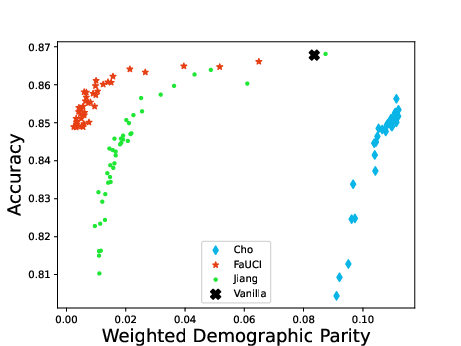
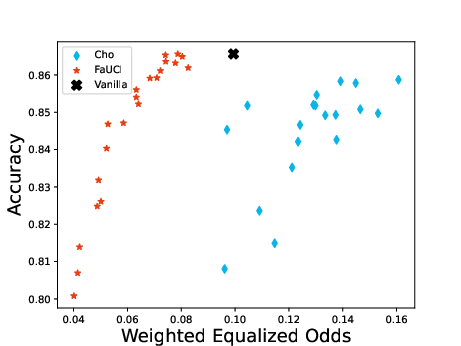
$$WDP_{h, A}(X) = \sum_{a \in A} \left|\left| E[h(X) \mid A{=}a] - E[h(X)] \right|\right| \cdot w_{a}$$ $$WDI_{h, A}(X) = \sum_{a \in A} \eta\left(\frac{E\left[h(X) \mid A{=}a\right]}{E\left[h(X) \mid A{\ne}a\right]}\right) \cdot w_{a}$$ $$WEO_{h, A}(X) = \sum_{(a, y)}^{A \times Y} eo_{h, A}(X, a, y) \cdot w_{a}$$
Continuous
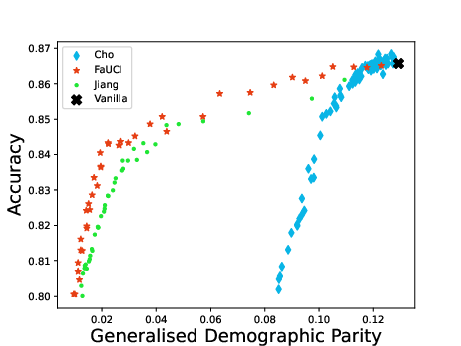
$$GDP_{h, A}(X) = \int_{l}^{u}(\left|\left|E[h(X) \mid A{=}a] - E[h(X)]\right|\right| \cdot w_{a}) \cdot da$$ $$GDI_{h, A}(X) = \int_{l}^{u} \eta\left(\frac{E\left[h(X) \mid A{=}a\right]}{E\left[h(X) \mid A{\ne}a\right]}\right) \cdot w_{a} \cdot da$$ $$GEO_{h, A}(X) = \int_{l}^{u} \sum_{(a, y)}^{A \times Y} (eo_{h, A}(X, a, 0) + eo_{h, A}(X, a, 1)) \cdot w_{a} \cdot da$$
FaUCI
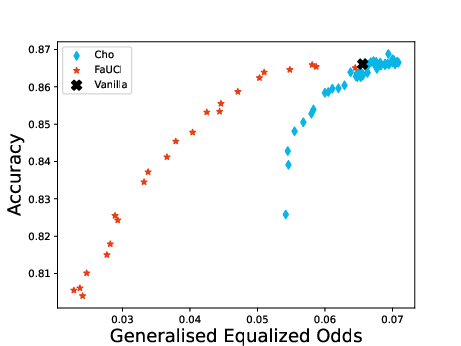
Results on the Adult dataset
Gender (binary)
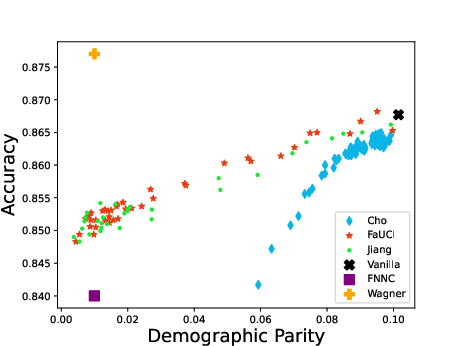
Ethnicity (categorical)
Age (continuous)
Future directions
Intersectionality
FaUCI can already be used to consider multiple protected attributes (subgroups) at the same time. However, we still need to perform a wide empirical study of the method to understand its performance. $$L_{h,\bar{A}}(X, Y) = E(h(X), Y) + \lambda_{1} F_{h,A_1}(X) + \dots + \lambda_{n} F_{h,A_n}(X)$$
Language for fairness
We want to develop a language to help users to define ad-hoc fairness constraints in a more intuitive way. Many potential users do not have a strong background in ML and statistics, so we aim to make fairness techniques more accessible. This is something very similar to what happen with symbolic knowledge injection methods.
AutoML for fairness
Because the training of ML models requires many hyperparameters – and with the addition of fairness constraints there is usually one more – we want to use AutoML tools to study the convergence of the best hyperparameters and how well they perform. In this way we can fairly compare different fairness techniques and understand which one is the best.
Thank you for your attention!